Where Sublustrum takes place
Apartment, capsule, Flickering World, desert, harp tower, winter — rebuilt as explorable 3D, with 2008 layouts marked as history.
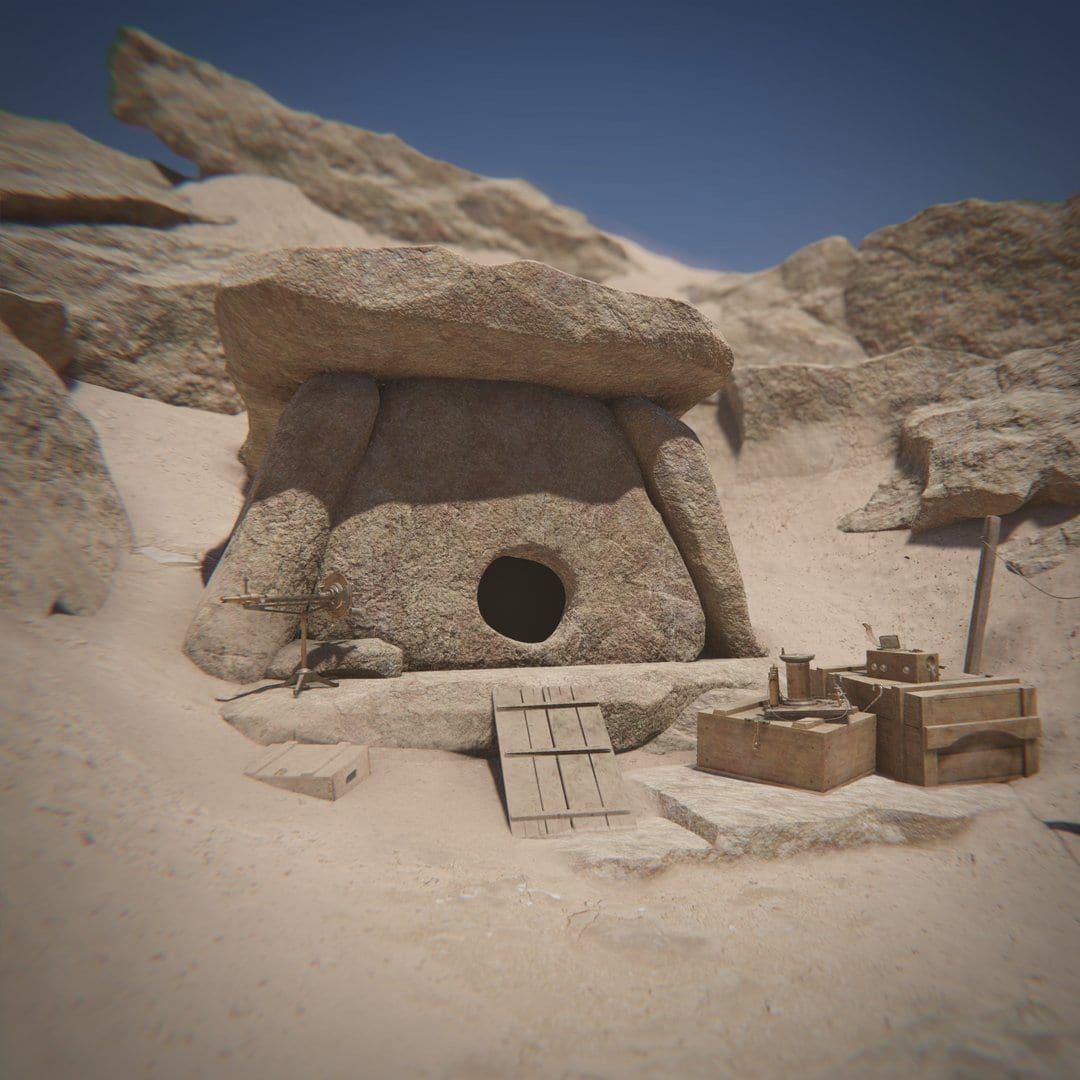
Sublustrum is a game of a few unforgettable places rather than an open world with a fog of war. You start in a brother’s apartment that is also a laboratory. You descend through a capsule into a mind that has been given architecture. The original English release called that architecture the Shimmering World; the remake’s store copy says Flickering World. Around 1916 imperial Russia is the earthly frame. What follows is industrial dream-space: deserts that should not sit behind a St. Petersburg wall, a tower that is a harp, a winter that behaves like an ending.
The 2026 remake does not paste those shots onto a new engine. Locations are rebuilt as full 3D spaces with free movement, photoreal materials, vintage lenses, and aged film grain. Treat every original room description on this page as historical context. Layouts, hotspots, and even which objects exist may change. For how you move through them, read How to Play Sublustrum. For why a tower is an instrument, read Sublustrum Sound Puzzles. For who you are following, stay spoiler-light on Sublustrum Story Explained until you want the marked section.
The brother’s apartment and laboratory
The opening is a home that has been used as an experiment. Hallway, sitting room, office, greenhouse, basement: the original stacked a writer’s visit onto a scientist’s mess. Gramophones, diaries, a military newspaper, botanical notes, and devices that do not belong next to a sofa teach you the tone before any otherworld appears. The visual brief for the remake is Victorian melancholy against industrial structure — brass, dust, cloth, and machines that look as if a 1916 workshop had been asked to build a soul a vessel.
In 2008 you clicked from node to node. In 2026 you should be able to walk the length of a corridor, stand too close to a cabinet, and miss a note because you looked at the window instead. That is the point of free movement. The first-chapter playtest is the place to learn this house as a 3D space. Do not expect the retail map to be a perfect copy of a GameBoomers room list.
Capsule, organophone, and the descent
The brother’s last experiment sits in the apartment like a diving bell. Original players repaired power, mixed an inhaler from greenhouse work, took a code from the organophone in the office, and rode the capsule into the otherworld. The remake still asks you to repair a machine and step inside. The exact ritual is allowed to change; the function is not. This is the threshold between a naturalistic interior and a mind that has been given rooms.
The organophone deserves a location note as well as a puzzle note. Visitors in the diaries treat it as if the professor were giving music lessons. It is furniture that is also a tuner, parked in an office that is also a lab. If the remake keeps an instrument in that first interior, walk around it. The 2008 camera hid as much as it framed.
Flickering World (originally Shimmering World)
Once you are through the machine, the apartment does not stay obedient. The original presented warped domestic space: boards over drops, a greenhouse that had become a workshop, mechanisms on tables that moved bridges elsewhere, a time key that opened a past boiler room. It is the same address dreamed harder. Psychoanalysis books and megalith texts lie where a novel might have put ammunition.
The remake describes a realm that shifts, overlaps, and rewrites itself as a fractured psyche tries to hold together. Liminal halls, ornate Victorian machinery, and hollow places where the dark feels inhabited are the language the trailer is selling. Because you can now free-walk, these overlaps can be spatial rather than a cut to a new still. A gravity shift can turn a familiar parlour into a shaft. A temporal distortion can put two versions of a doorway in the same wall.
Sound is the compass here. Official copy says only sound remains trustworthy when reality dissolves at the edges. If a corridor looks wrong, listen before you sprint. There is no combat loop waiting at the far end; there is another machine, another memory, or another room that used to be a greenhouse.
Desert town and the tram
Later original chapters left the house for a ruined desert settlement: a safe, a torn map, a tram, a fountain, a temple, a conversation through a hatch with a figure walkthroughs often call Animus. It reads like a ghost town assembled from guilt and scholarship rather than from a travelogue of Central Asia. You gather mechanical parts that belong in a cathedral as much as in a depot. A storm is coming, the tram needs water and an embryo in its turbine, and the code to a safe is sitting on a number plate if you bother to wipe the dust.
Whether the remake keeps a desert as a discrete chapter or folds it into a larger Flickering World is a 2026 question. The studio has promised new locations and extra hours, especially in chapters that originally shrank as the budget died. If a desert returns, expect it to be walkable, not a handful of panoramic nodes. If it does not return by that name, expect its tram-and-temple logic to show up inside another dream.
Harp tower
The tower is the location people remember when they say the game is a musical instrument. Original players rode an elevator through floors of valves, aimed a harp at the loudest correct sound, moved pollen between mechanical flowers, and seated a metal fruit in a core so a door would open. You do not clear the tower of enemies. You tune it until it accepts you.
The remake’s claim that one entire location is a vast instrument you must play and tune is this idea grown to a 3D stage. Walk the body of the instrument. Look for resonance, not for a painted arrow. Pair this section with the Sound Puzzles page if you want the listening grammar rather than the floorplan. Pair it with original versus remake if you are trying to remember which 2008 floors were already shrinking from lack of time.
Winter, ice, and the last walk
The original finale is snow. Shadows lead you from a scrap of diary to a bench, an alley, a pier, a hole in a pond. There is no boss yard. There is a walk that feels like letting go, which is the theme the remake still names in store text. Readings of who you were — writer, scientist, split self, childhood guilt — gather here, which is why this wiki keeps a separate endings page. This locations article will not grade those readings. It will only say that the last original space is cold, quiet, and shaped like a piece of music ending rather than like a dungeon collapsing.
The remake adds extra endings and still wants the open feeling preserved. That may mean more than one winter, or winters that are not snow at all. Until the full game exists, treat ice as a 2008 place, not as a spoiler screenshot for Fall 2026.
How to use this map while the remake is unfinished
If you are entering the September 2026 playtest, stay in the apartment mentally. Learn the 3D house. Do not binge a desert route you may never be asked to repeat. If you are a 2008 veteran, walk the remake as a stranger; the point of free movement is that old node memory will lie to you. If you want a click-by-click museum of the original, open the original walkthrough primer. If you want to know whether the project is for you at all, wait for a session and then read the review.
Visual language is consistent even when geography is not. Photoreal 3D, Victorian melancholy, industrial silhouettes, early-twentieth-century retrofuturism, vintage glass, film grain. If a place does not look like it could have been photographed on aged stock, you may have left the intended mood — or the playtest may still be blocking out lighting. File that as feedback, not as a lore twist.
The Guides Hub lists every article in this category, including Getting Started with Sublustrum if you still need headphones and an SSD more than you need a desert. Price is unannounced. Consoles are unspecified. The finished product is not in shops. These locations are a map of a memory that is still being rebuilt.
Frequently Asked Questions
Quick answers to the most common questions.
Is the whole game the brother's apartment?
No. The house is the threshold. The Flickering World, desert, harp tower, and winter are later spaces. Sublustrum Story Explained places them in the plot without turning this into a finale page.
Why do some articles say Shimmering World?
That was the original English name. The remake's store copy uses Flickering World. Same idea: a memory realm past the capsule.
Will the remake add new places?
Yes. The team has promised new locations and extra hours, especially where 2008 chapters shrank. See original versus remake for what is being rebuilt versus added.
Is the harp tower a combat arena?
No. It is an instrument you tune. Sublustrum Sound Puzzles covers the listening grammar, including original harp and organophone examples as history.
Can I get lost now that it is 3D?
You can miss objects a 2008 node would have framed for you. Move slowly and listen. How to Play is the habit page for free movement.
Where are ending spoilers?
On the endings page, not here. This article stops at naming winter as the original last walk.