How Sublustrum plays in 3D
Free movement replaced point-and-click nodes. Listen first, read everything, and do not wait for a gun.
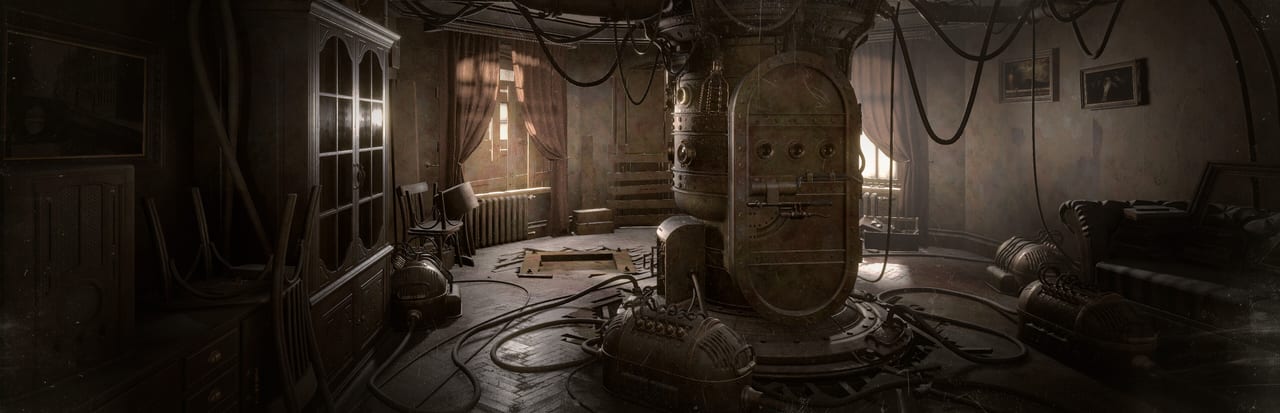
Sublustrum plays as a first-person adventure, not as a tactical shooter that borrowed a gloomy filter. You walk a photoreal space, pick up what the apartment and the Flickering World will give you, and solve machines that care more about pitch and association than about DPS. The 2026 remake is single-player. There is no second-player slot, no drop-in friend, and no PvP queue hiding behind the capsule. If you came from the 2008 original, the biggest mechanical change is not a new inventory grid. It is that the rooms are no longer a graph of clickable camera nodes.
This page is the playbook. Pair it with Getting Started with Sublustrum for wishlist and playtest setup, and with Sublustrum Sound Puzzles when a device starts behaving like an instrument. Geography belongs on Sublustrum Locations. Hardware ceilings belong on system requirements.
From point-and-click nodes to free movement
The 2008 Sublustrum / Outcry was a first-person point-and-click adventure. You stood in a composed shot, moved the cursor, and hopped to the next hotspot. That style made every frame look like a still from an old film, which matched the grain, but it also meant you never truly circled a diving-bell capsule or walked the length of a hall to hear how a pipe changed.
The remake throws that constraint out. Phantomery is rebuilding locations as full 3D spaces you can cross on foot. Vintage lenses and aged film grain are still part of the look — the team is not chasing a glossy action-game finish — but the camera is yours. You will miss objects that used to sit in the centre of a pre-baked view. You will also catch details a node camera would never have let you stand beside: the underside of a mechanism, a diary that fell behind a chair, a window that only makes sense from the far wall.
Play it like a walking investigation, not like a hidden-object hunt on a timer. Slow down at thresholds. Look up. Look behind you after you throw a switch. The original trained people to click every pixel; the remake trains people to occupy a room.
Controls: what is fair to assume, and what is not
A full control table for the 2026 game has not been published as a final document. Treat anything you read here as an expectation to confirm in the chapter-one playtest, not as a binding overlay.
Because the remake is a first-person 3D adventure, the reasonable default is a look-and-move scheme in the same family as other modern PC adventures: WASD to walk, mouse to look, a key to interact, a key to inspect or zoom, inventory on a dedicated button, and Escape for pause. Controllers may be supported later; do not assume a console binding until the store page or in-game prompts say so. Rebind if the playtest allows it. If interact and inspect are separate, do not mash them as if they were one context action from a shooter.
Do not bring a tactical-sprint muscle memory into the apartment. There is no published cover system. There is no published gun. If the playtest shows a hold-to-listen or a hold-to-tune prompt, that is the verb that matters. Write your personal binds down; the wiki will update this section when the team ships a final overlay.
The loop: look, read, listen, operate
A session of Sublustrum is a cycle.
You enter a space and you look. Victorian furniture sits against industrial frames and early-twentieth-century retrofuturist machines. The mix is deliberate. If something looks like it belongs in a laboratory more than in a sitting room, it is probably part of the brother’s work.
You read. Diaries, newspaper scraps, botanical notes, and recorded cylinders are not flavour text you can skip if you want to understand a valve. The original hid scissors, codes, and plant ratios in pages people walked past. The remake has more text and more connective tissue; that means more chances to miss a sentence that later becomes a frequency.
You listen. Audio is a mechanic. Hum, hiss, a change in room tone, a voice in static, a bar that stops sounding like noise — those are inputs. Headphones make the difference between guessing and knowing. One entire location is a vast musical instrument that must be played and tuned before it will let you through. That is not a metaphor the marketing team invented for a trailer; it is how the space is supposed to work.
You operate. Capsules, organs, valves, bridges, harps, and whatever new devices the remake adds are interacted with as objects in 3D, not as 2D mini-games pasted on a still. If gravity shifts or time distorts, the room itself is the puzzle. Walk the new orientation. Do not wait for a cutscene to explain that the floor has become a wall.
Then you move on. There is no loot treadmill and no crafting tree. The reward is a door, a memory, a recording, or a clearer picture of why the brother never came back.
What this game is not
It is not a combat loop. You will not be clearing rooms of enemies for XP. Psychological pressure and surreal architecture are the threat model, not a health bar.
It is not a multiplayer live service. Brickworks and Phantomery are shipping a authored adventure with a Fall 2026 window. You will not be grouping up to farm the harp tower.
It is not a 1:1 remaster of the point-and-click original. Puzzles are reworked for 3D. Chapters are longer. New scenes exist. Extra endings exist. Solutions you memorised from a 2008 text walkthrough may be wrong on purpose. Use the original walkthrough primer as history, not as a spoiler sheet for the playtest.
The finished remake is still upcoming. If a prompt in the playtest feels rough, that is the point of a first-chapter test. Log it, do not treat it as the retail build.
Practical habits that make the remake easier
Wear headphones from the title screen. Keep an SSD if you have one so film-grain interiors do not hitch mid-tune. Read items in inventory, not just the pickup toast. When a machine has several sliders, change one at a time and wait; sound puzzles punish people who wiggle everything at once. If you are stuck, leave the room and come back after another document. Lateral thinking is the design. The answer is often a connection between a memory, a drawing, and a noise, not a missing pixel.
If you want story structure after you understand the verbs, read Sublustrum Story Explained. If you want to know how the 2026 game differs from Outcry before you unlearn old codes, read original versus remake. Save endings and the review until you have an actual session behind you. The Guides Hub lists the full set.
Play slowly enough that the grain and the soundtrack can do their job. Anthesteria’s music is not a menu playlist. It is the oldest part of the project. If you treat Sublustrum like a checklist of interactables, you will finish rooms and still have no idea what the Flickering World was trying to say.
Frequently Asked Questions
Quick answers to the most common questions.
Is the remake still point-and-click?
No. The 2008 game used first-person hotspots. The remake is free-move 3D. Getting Started is the right page if you have not even installed the playtest yet.
Are the final PC controls published?
Not as a frozen overlay. Expect WASD and mouse look for a first-person adventure, then confirm binds in the playtest.
Is there a combat or stealth campaign?
No combat loop is part of the advertised design. You explore, read, and operate machines. Sound-driven challenges are covered on Sublustrum Sound Puzzles.
Can I play with a friend in the same session?
No. Sublustrum is single-player. A second person can sit on the couch and help listen, but the software does not host two players.
Do I need a high-end PC to learn the controls?
You need a machine that meets Steam's specs and, ideally, an SSD. Check system requirements before you treat hitching as a control bug.
Where do I go after I understand movement?
Tour Sublustrum Locations if you want the apartment and Flickering World in your head, or stay in the room and listen until the next machine makes sense.