Sublustrum Endings
The 2008 winter scene, the readings fans still argue, and what the remake has actually promised.
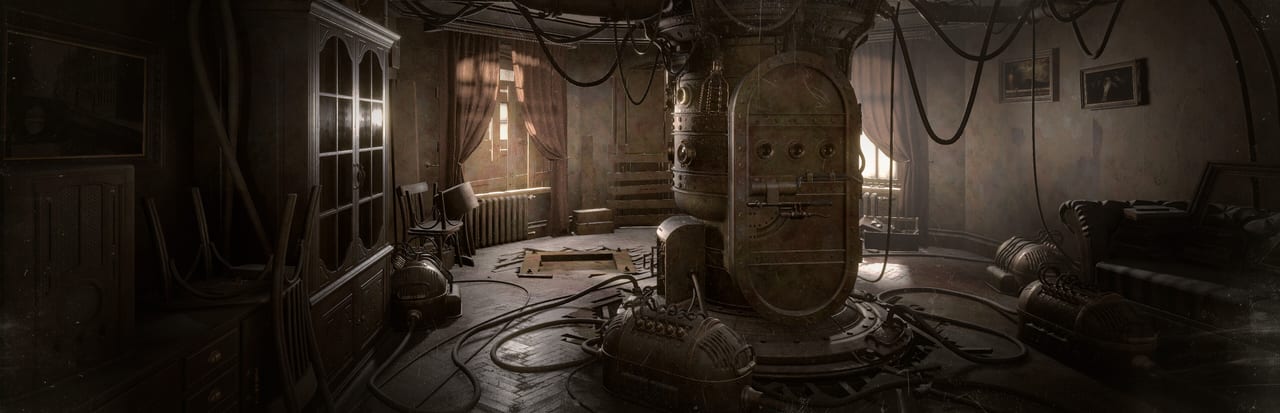
This page is spoiler-heavy. It describes the last sequence of the 2008 Sublustrum / Outcry and the main ways players have tried to make that sequence mean something. It does not invent named finales for the 2026 remake. Georgy Beloglazov has said the remake keeps the original’s openness, adds extra endings, and includes at least one alternative ending plus a still-secret piece of context. Until the finished Fall 2026 game exists, those additions have no official titles here.
If you want the plot without the ice, use the spoiler-light story page. If you want the journey’s shape without every interpretation, use the original walkthrough primer. If you want craft instead of canon, use original vs remake and the review.
What the 2008 game actually shows
After the harp tower, snow. Diary pages about a childhood steamboat test. The brother standing in the white. A gramophone. A pier. A crack in the ice. You walk into the water. You see the brother again. The game returns to the language of the opening letter. Credits. There is no ending select, no rank, and no on-screen label such as true or false.
Before that walk, the apartment recording told you to destroy the work. The Shimmering World showed memory as architecture and let you push on the past through a time key. A phone voice spoke about a split of reason, about shadows, about following white light. A greenhouse note tied Albertia fumes to dissociation. None of those documents stand up at the end and declare a winner. The winter is a scene, not a verdict.
Igromania’s 2008 review caught the design: the finale asks who you were, where this happened, and with whom, and then allows several answers that can each feel complete. Western outlets often called the same scene confusing or abrupt. Both reactions are fair. The studio left gaps on purpose and because a tiny 2008 budget ran out of chapter.
Readings fans still use
Russian and English discussions tend to circle four families of reading. They are fan tools, not developer DLC.
One: the scientist’s brother died in childhood, in water. The professor, eaten by guilt, built a machine to re-enter memory and save the boy at least inside the mind. The experiment kills him. The apartment you explore and the writer you play are products of a dying brain. When the ice closes, the professor dies, and so does the world he was projecting.
Two: the professor does change the past. The boy lives, grows up, becomes a writer, and arrives at the apartment as the player. The brothers still miss each other. In some tellings the professor gives his life for that rewrite and remains trapped on the other side, which is why the living writer only meets him as a trail of notes.
Three: you are the writer, the brother really vanished into the Shimmering World, and the winter is the last memory you are allowed to share before the experiment ends. The white is not a metaphor for death so much as the edge of a place that will not let you stay.
Four: there was never a separate brother. The writer is a second self, a split, a Shadow given a profession. Albertia’s dissociation, mixed diary voices, and the professor’s confusion about whose notes he is reading all get cited here. The player is the professor meeting a fragment, or the fragment meeting its author. The childhood drowning is a trauma that split one person, not a second body under the ice.
You can mix these. Plenty of players hold that the machine is real and the personality split is also real. Plenty hold that none of it is diegetic science and all of it is grief. The 2008 text will not pick for you. Beloglazov has since said the story is soaked in Jung: Shadow, archetypes, the inner journey toward the Self. That interview language supports reading four without erasing one, two, or three.
Why the original refuses a single moral
Sublustrum is about the wish to repair a past that will not be repaired, and about what remains when you stop trying to occupy someone else’s mind. The Steam page for the remake says as much in clean prose: grief, the impossibility of changing the past, the long work of letting go, and what is left of the other person — and of you — when you finally do. That is not a new marketing twist. It is the 2008 winter restated without the ice.
The game also refuses to make the Shimmering World a tourist afterlife. Stay too long, the notes say, and the body may not come back. Follow the white light. The last walk does the opposite of a victory lap: it goes down into dark water. Players who wanted a rescue cutscene felt cheated. Players who wanted a psychological adventure felt seen.
What the remake has promised, and what it has not
The remake keeps the open ending. Beloglazov has said so directly. The team also added extra endings and new scenes, and expanded story branches they did not have time to build in 2008. In one interview he mentioned at least one alternative ending. In another he said an important extra element will help you understand context, and that he would not describe it yet.
This wiki will not name those remake endings. There is no confirmed list of titles, no confirmed checklist of flags, and no confirmed last shot. Anyone posting a 2026 ending name before the finished game ships is guessing. The September 2026 playtest is the first chapter only. It is the wrong place to hunt finales.
What you can reasonably expect is more than one way to leave the Flickering World, plus more connective tissue so the winter — or whatever replaces the winter — does not feel like a chapter that ran out of money. You should not expect a PowerPoint that declares the writer is or is not the professor. Openness is the feature being preserved.
How to play toward meaning without a spoiler checklist
Read the documents. Listen when a machine wants a tone instead of a number. Notice when the game repeats a childhood image. If you play the 2008 original, sit with the ice before you open a forum. If you wait for 2026, go in knowing that extra endings exist and that the studio still wants you to argue afterward.
A longplay of Outcry: The Dawn sits in the middle of this page so you can see the 2008 last act in motion, including the desert and harp that feed it. Use it as evidence of tone, not as a routing guide for the remake. For the itinerary that leads to winter, the original walkthrough primer stays lighter on interpretation. For how 2026 changes structure, stay on original vs remake. For whether this kind of ending will satisfy you at all, the review is the better pre-purchase read, and the story page is the better pre-spoiler read.
Until Fall 2026, the only ending this wiki can describe with a straight face is the 2008 one: snow, water, a brother, a letter, and a set of readings that all fit if you let them. That ambiguity is not a bug the remake is quietly patching out. It is the part of Sublustrum the original director has said he is carrying forward.
Frequently Asked Questions
Quick answers to the most common questions.
Does the 2008 original have multiple named endings?
No. It has one last sequence that players interpret in several ways. There is no in-game ending title.
Will the 2026 remake keep that ambiguity?
The director has said the openness of the ending remains, and that extra endings and added context are coming. No official remake ending names are confirmed.
Is the writer a split personality of the professor?
That is a popular fan reading, not a stated fact. Other readings treat the brother as a child who died, a man saved by changing the past, or a real missing scientist.
Can I hunt remake endings in the September 2026 playtest?
No. The playtest is the first chapter. Finales belong to the finished Fall 2026 game, which is not out.
Where should I read if I want fewer spoilers?
Use the story page and stop before this one. Come back after a 2008 longplay or after the remake ships.
Is there a good ending and a bad ending in 2008?
The disc does not grade you. People call the winter tragic, merciful, or empty depending on which reading they hold.